

MEET THE FRENCH BULLDOG
The Clown in the Cloak of a Philosopher
French Bulldog Breed Information
The French Bulldog is a companion Dog. The Breed is small and muscular with heavy bone structure, a smooth coat, a short face and trademark “bat” ears. Prized for its affectionate nature and balanced disposition, they are generally active and alert, but not unduly boisterous. Frenchies can be brindle, fawn, white and brindle and white.
History:
In the latter part of the 19th century, the lace makers of Nottingham, England began selectively breeding a smaller Bulldog as a lap pet. Displaced by the Industrial Revolution, many of the lace makers crossed in the English Channel, taking their small bulldogs with them to France. Some of these toy or miniature bulldogs made their way to Paris, where well-to-do Americans on the Grand Tour of Europe saw them and began bringing them to the US. In 1897, the French Bull Dog Club of America was formed, the first Club in the world dedicated exclusively to the welfare of the wonderful breed.
Breed Standard:
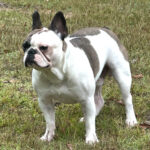
The AKC Breed Standard describes “an active, intelligent, muscular dog of heavy bone, smooth coat, compactly built, and of medium or small structure. Expression alert, curious and interested. Allowed colors are brindle, fawn, white, brindle & White or fawn & white ( which are termed “pied”); chocolate/liver, grey/mouse, black & tan, or merle colors are not acceptable coat colors.
General Care:
French Bulldogs don’t require a lot of grooming and generally do well in small living quarter. They are not noisy and most of them are very fond of people, though there are individual differences in how well they get along with other animals. They should never be allowed to run free, and should only be allowed outdoors in a fenced yard or on a leash. French Bulldogs must never be left unattended around water, as they are poor swimmers and can easily drown due to their front-heavy structure. French bulldogs do best in moderate temperature and should be carefully supervised in both high and low temperature ranges. Panting and shivering are both indications of excessive exposure. In warm and/climates or humid environments, (over approximately 70 degrees F), air conditioning in the house and car are a must! Indestructible dog toys are best, as those powerful bulldog jaws can destroy less durable ones; and rawhide type chews should not be used because when they soften they can become lodged in a Frenchie’s throat.
Occasional brushing keeps the coat shiny, and regular nail trimming is a must since many dogs don’t usually wear their nails down by running. Regular cleaning of the ears and of the deep facial folds will prevent these sensitive areas from becoming irritiated, and regular checking of the anal sacs will prevent problems with these. Your vet can advise you on how to caer for the ears, skin folds, and anal sacs as well as on feeding your puppy. It is important that dogs be kept at an appropriate weight; and obese French Bulldogs is at a far higher risk for many of the breed’s health issues.
Health Care & Concerns:
Find a good veterinarin, preferably one who has other short-faced patients; and provide your Frenchie with regular checkups, routine vaccinations, tests for intestinal parasites, heartworm prevention, and flea & tick control. Your vet should do regular dental checkups and care, and you should clean your dog’s teeth regularly at home as well.
As a short-faced,(“brachycephalic”), and dwarf breed, (“chondrodystrophic”), French Bulldogs may have some health concerns that you should be aware of. The short face can make their breathing less efficient than that of long-nosed breeds, so Frenchies have less tolerance of heat, exercise, and stress – all which increase their need to breathe. Keep your French Bulldog cool in warm weather an avoid strenuous exercise. If your dog seems to overheat or become stressed too easily, with noisy breathing and sometimes spitting up foam, consult the vet and have its airway evaluated for pinched nostrils or an elongated soft palate. Anesthesia is also more risky in short-faced dogs, so be sure your veterinarian is experienced with such breeds should your Frenchie need to be anesthetized for any reason.
The spine also merits special attention. Like other dwarf breeds, the stocky French Bulldog may also have abnormal vertebrae and/or premature degeneration of the intervertebral discs. While the spine is supported by good musculature, herniation of degenerated disc can cause major problems, and most symptomatic back problems are due to disc disease rather than to abnormal vertebrae. All dogs should have a thorough musculoskeletal exam by a veterinarian, but most Frenchies can safely engage in regular moderate exercise, which is essential to help maintain healthy weight and good physical condition.
Training:
A crate trained puppy is easier to housebreak. A dog regards its as its den, a safe haven and home. If you travel, the dog is safest in his crate in your vehicle and also when you stay in hotels or visit other people. If he should be ill or injured and need to be kept quiet, this is much easier if he is happy in a crate. In warm areas, cooling pads and fresh water should be placed in the crate too. The breeder of your puppy can advise you how to crate train and housebreak your puppy.
Take your French Bulldog to training classes as soon as your veterinarian feels he has proper immunity. This will get him accustomed to being around other dogs and people, will teach you how to communicate your wishes to him, and will teach him such basics as walking well on a lead, sitting, staying, and coming on command. Although cute and cuddly-looking, a French Bulldog has a big personality and needs an adequate amount of training to make it a civilized companion.
Contrary to the stereotype as “stubborn” most Frenchie’s strive to please their owners and are therefore very trainable with the proper motivation (usually food). There are now many French Bulldogs who compete very successfully in obedience, rally, agility, and a few have even done field work ( tracking, coursing, herding). They can also be excellent working dogs in all kinds of Therapy Dogs roles in volunteer setting such as schools, nursing homes and hospitals
Spaying, Neutering or Breeding?
If you are considering breeding your French Bulldog, and bought it with the breeder’s understanding that you intend to do so, please take this responsibility very seriously. Be sure that your dog conforms well to the breed standard and has a good temperament, being neither overly aggressive nor overly shy. Your- should consider breeding only after careful study of the breed standard, educating yourself about the breed’s health issues, and honestly evaluating your dog’s conformation and health. Be sure that you will be able to place all puppies in good an loving homes, and should these placements not work out, that you would be able to take back the puppies.
If you bought your French Bulldog as a pet, you should consult with your veterinarian about the appropriate age for spaying/neutering.
Whatever your plans for your new Frenchie companion might be, be prepared to be enamored with them in no time! Your “clown in the cloak of a philosopher” will fast become a treasured member of your family and keep you smiling all day long.